Reviews

2001: A Space Odyssey (1968)
R Remix_BenJanuary 30, 2024
This is the groundbreaking work of the modern sci-fi genre, a philosophical film about the evolution of civilization, an epic among epics. When we contrast the insignificance of humanity with the vastness of the universe, it deepens our contemplation of our own destiny. As the magnificent symphony plays, it ushers the thoughts of life roaming through an unknown universe with no beginning or end, exploring its own ultimate meaning. Great films are immortal, and so is the great Kubrick.
2001: A Space Odyssey (1968)
B BERENGÁR@1January 30, 2024
You have to tough it out and watch it the first time, feeling like you have no clue what it's all about. When you give it a second go, you might start to feel like it's beginning to make some sense. By the third time, you'll realize it's actually delving into multiple themes. After the fourth time, you might feel like you've got a handle on something. By the fifth time, you'll be thinking, "OMG, this is absolutely incredible! And it's from 1968!"

His Girl Friday (1940)
T tinaShayJanuary 30, 2024
Adapted from a stage play, this movie condenses lengthy dialogue into rapid exchanges, and the performances, both in the foreground and background, are truly memorable. Having previously watched "Bringing Up Baby”, I found this film to be somewhat lacking in comedic punch, but it delves into its own societal themes, making it an entirely different kind of film. The twist where the charmingly mischievous Cary Grant still manages to win the leading lady's heart in the end is quite intriguing.
His Girl Friday (1940)
Y YasminYYYJanuary 30, 2024
Howard Hawks is truly a versatile director, constantly pushing the boundaries across various film genres. This movie could easily be one of the fastest-paced and most dialogue-packed works in film history. Not only does it rely heavily on dialogue for humor, conflicts, and plot development, what's even more impressive is that many scenes have multiple people talking at the same time. To help the audience process the dense dialogue, the film's editing is kept very simple, opting for long takes and very few transitions. These elements demand highly of the actors' performances as well as good Mise-en-scène. As for the content, I believe that even if you were to watch it today, it wouldn't feel outdated.
His Girl Friday (1940)
R Rafaela977January 30, 2024
This might be the most dialogue-packed movie I've ever seen. The story mostly unfolds in just two main settings, but the sheer number of events is truly impressive. What's more, it has an open-ended structure and is incredibly deep in its messages, all presented through its subtle or direct depictions of news, politics, and love.

The Philadelphia Story (1940)
S stellarcallerJanuary 30, 2024
It's a classic film from the golden age, better than a lot of films out there. However, despite the amazing performances and characterizations by the three big stars, I felt the script came off as a bit too contrived. Even though it's a comedy where a happy ending makes sense, this conclusion still doesn't quite align with the theme. The way it glossed over what should have been deeper, along with the heavy-handed moralizing, left something to be desired.
The Philadelphia Story (1940)
S SuperDCM+January 30, 2024
The movie leans more on clever dialogue than a strong plot, but ultimately, the casting is the real win: Katharine Hepburn, Cary Grant, and James Stewart all click well both on and off screen. The tension in the story doesn't come from unexpected twists, it comes from the distinct yet complementary charisma of the three main actors.

Gold Diggers of 1935 (1935)
P pedroJanuary 30, 2024
The set design is really impressive, like the dazzling piano scene and the lively tap dance. However, the story completely falls apart, with an unclear main plot and a chaotic narrative. Additionally, there's a significant disjoint between the musical elements and the plot. While it would be great for a stage performance, as a movie, just the musical scenes alone are not sufficient to make it a complete package.
Gold Diggers of 1935 (1935)
S SuperMovieJanuary 30, 2024
The comedy part feels a bit too over-the-top, leaning heavily on clever lines and charismatic performances, which can come across as a bit exaggerated. The musical parts are close to perfection (in fact, Berkeley takes segments like this to the extreme in all his films), especially in the transitions of the musical scenes, where you can see a lot of creative and imaginative inputs.
Gold Diggers of 1935 (1935)
T Tusch74January 30, 2024
The treatment of light and shadow is sophisticated and flawless, showcasing a strong sense of abstract geometric lines and rhythm. Berkeley's grasp of cinematography is evident, but the overall downside of the film is that form takes precedence over substance.

Friday the 13th (1980)
L lexieeJanuary 30, 2024
Behold Jason Voorhees, one of the most respected serial killers in horror cinema: a classic! If someone keeps surrounding the Crystal Lake, you can count on Jason to keep killing innocent people, I always say: Keep it simple, follow the rules, and you will have a great slasher. With the characteristic gore of the 80's and great deaths, this movie is a killer.

The Ladies Man (1961)
C case283January 30, 2024
8.5 out of 10. The movie follows a recent college graduate as he navigates part-time jobs and romantic entanglements. The over-the-top absurd humor in the film is relentless. Overall, I'd give it an 8.5 out of 10, mainly for the absurd ideas; anything higher than that would require a better and more concise narrative. Also, it's worth noting that the use of space, camerawork, and scene coordination is quite interesting, and the humor is effectively generated through these elements.
The Ladies Man (1961)
P pixieneJanuary 30, 2024
The script itself is actually quite underwhelming. The flow and structure aren't bad, but they generally lack innovations. What really surprised me was the exaggerated, unrealistic, and intentionally rough set design and editing to closely match the visual direction of the film, which works surprisingly well. They showcase the unique flair and aesthetics of a particular period. Jerry Lewis' performance is indeed over-the-top, but it's impactful nonetheless, and I have to admit that the director is quite good when it comes to casting.
The Ladies Man (1961)
T Timeae4UJanuary 30, 2024
The opening scene showcases the apartment as if it's sliced in half like a cake, revealing the artificiality of the set, which is quite smart and entertaining. George Raft plays himself, being teased and joked about by Jerry Lewis, and there are also plenty of satires and tearing down of hypocrisies and pointless opulence, which is very satisfying to watch. Jerry Lewis's films usually don't contain a complete story. Instead, they're a series of skits that come together to create a completely irrational yet fun watching experience. The more you embrace the way it's presented, the more enjoyment you'll find.

Twentieth Century (1934)
L Let's Talk About...January 30, 2024
This is one of Howard Hawks' early comedies, but I think it falls short of his best comedic work. The actors' performances in the film are quite theatrical and, to me, lack the comedic touch. Carole Lombard also doesn't bring her usual charm to the role. The scenes on the train aim for screwball comedy, but it feels like they're forcing a neurotic character to create the humor. All in all, it’s kinda disappointing.
Rear Window (1954)
TtinaShayJanuary 30, 2024
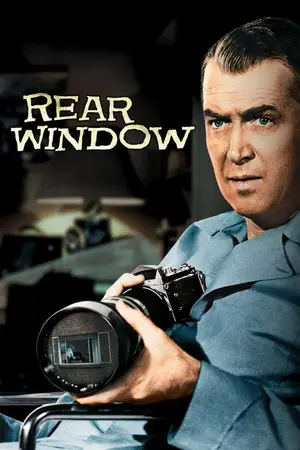
tinaShayJanuary 30, 2024This presents a dual perspective from inside and outside the frame, showing that observers might not always have a clear view and curiosity can sometimes lead to unexpected consequences. The complexities of marriage are also talked about. François Truffaut once remarked that what struck him the most in Hitchcock's films was that all love scenes were shot like murder scenes, and all murder scenes were shot like love scenes... Love and death are intricately intertwined themes in Hitchcock's works.
Rear Window (1954)
PpixieneJanuary 30, 2024
pixieneJanuary 30, 2024This is my fourth time watching it, and it's one of the films that first got me hooked on cinema. It's also my favorite among Hitchcock's works. Hitchcock has this amazing ability to build suspense and excitement in a confined space by using his incredible storytelling and precise control of the camera. The rear window just feels like a whole other world within the screen, stretching the unknown beyond the familiar frame. The movie also delves into marriage themes and offers reflections on voyeurism and moral criticism. Hitchcock's films typically start with chaos, build up conflict, and then wrap up with a calm resolution. I just adore his work so much.
Rear Window (1954)
TTimeae4UJanuary 30, 2024
Timeae4UJanuary 30, 2024The director's command of framing techniques within a confined space is truly masterful. Most of the shots are made to mimic "peeping", which has the power to convey a sense of scrutiny and observation. Yet, the transition of various observing media, such as human eyes, telescopes, and cameras, makes the entire film visually captivating. Different characters moving in and out at different depths of the field and the presence of a secondary storyline behind each window all interweave and intertwine to create a unique "multilinear narrative."

And the Ship Sails On (1983)
W wickeremergedJanuary 30, 2024
At first glance, I thought it was one of Fellini's earlier works based on the visuals, but it's actually a later piece from 1983. The set design and music are just amazing. This is probably Fellini's most straightforward critique of the middle class. The performances also have a distinct theatrical quality. It begins with a black and white silent film opening, then the middle section offers a long and intentionally tedious portrayal of the upper class through a journalist's viewpoint, and the final part features a scene of refugees boarding the ship, which is a stark contrast to the previous segment.
And the Ship Sails On (1983)
T thinkmillerJanuary 30, 2024
This film represents Fellini's shift from making silent movies to producing colored, voiced films. Cleverly making voice-over as an actual "character" and integrating classical music and opera, Fellini seemed to be more and more free to experiment with different approaches in filmmaking as he got older. The indoor scenes are truly stunning, and the mise-en-scène remains fantastic. As the camera pulls back to unveil the actual screen, the movie successfully breaks the 4th wall.