Nouvelle Vague, Two or Three Things I Know About Godard
Directing
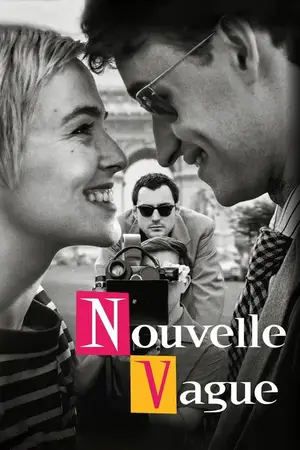
Premiering in Cannes, Nouvelle Vague is Richard Linklater’s carefully crafted black-and-white portrait of his “French film teachers.” It also feels like the work of a devoted student—tenderly titled Memories of My Teacher—made with deep affectoin. The whole film is lovable and neat, defying mistakes or curiousness, and in doing so, it resists any surprising flashes of brilliance.

Of course, this is only cross-generational inheritance between masters and pupil. Growing up in Texas, Linklater was a diligent self-taught student who spent countless hours watching films in video stores and film libraries. It is clear that French New Wave cinema would reach him through American campus culture and independent festivals. Linklater has also said many times in interviews that he admires the French New Wave, because those films showed young people like him that all you need you to start shooting was a camera in hand.
There's a similar moment in Nouvelle Vague. Linklater designs a scene in which Italian master Roberto Rossellini, after giving a short lecture at the Cahiers du Cinéma office in Paris, is escorted to the airport by Jean-Luc Godard, who is about to start work on his first feature Breathless. On the way, the Italian neorealist master earnestly advises the rebellious French youth to make films in the simplest, most intuitive way, without being bound by any fixed forms or methods.
The opening of Nouvelle Vague will make today’s cinephile audiences—especially those of us who can still barely be called “film critics”—deeply envious. Imagine it: a few young critics, relying on nothing more than a magazine (Cahiers du Cinéma), could invite renowned directors to give lectures; after a premiere, they could call directors by their first names and even half-jokingly claim their new work would probably be the “worst film of the year.” Fan readers gather in a corner, identifying one by one these young men of Cahiers who already had, or would soon have, their own films. Some female fans would even step right up and confess their admiration to Claude Chabrol. Of course, Richard Linklater, ever reverent toward his teachers, leaves out any hint of groupie-style entanglements.
Looking at the present, social media has long since shattered traditional media. The film critics who once held sway are already outdated, while the pen has passed to the keyboards of the masses. In this democratized arena, quips and punchlines are far more popular than the obscure, academic style of writing once favored by the Cahiers critics.

François Truffaut, Claude Chabrol, Louis Malle, Jacques Rivette, Éric Rohmer, Jacques Demy, Agnès Varda… the names of these “New Wave” masters appear one by one in bold title cards. The figure most revered by Richard Linklater—and the film’s clear protagonist—is, of course, Jean-Luc Godard. In the story’s settings—whether at the Cannes premiere, the Cahiers du Cinéma office, by the Seine, or on set—the relationships among these young men are strikingly harmonious, free of the rivalries one might expect among intellectuals.
To highlight the birth of Godard’s first feature Breathless, the film carefully builds up his character. He may act nonchalant, but there is also a hint of anxiety. At a café, he confides to a producer that all his colleagues at Cahiers already have their own features—Chabrol has even made two, and Truffaut is a year younger than he is. For Godard, the pressure is clear: he must, and urgently, make his own crime film, Breathless.
Everything falls into place naturally. Jean-Paul Belmondo, seen training in a boxing gym, quickly agrees to take the lead role. The already well-known American actress Jean Seberg assumes she will be in a project involving Truffaut, but upon learning that the writer-director is entirely Godard, she accepts politely without much hesitation. What was meant to be a tightly scheduled 20-day shoot is casually interrupted by Godard, who freely gives everyone a day off. He brings in Raoul Coutard, who had worked as a military cameraman in Indochina, and shoots without synchronized sound, without lighting, often wrapping important scenes in a single take. Even when props or lighting were completely inconsistent between shots, the director never asked for corrections, thinking it could all be fixed later in editing. This reckless, willful, almost haphazard approach left the producer extremely anxious—for after all, only the producer was accountable to the investors. As a result, the producer becomes the only anxious figure throughout the film.
In editing, those mismatched props and lighting, those scenes that broke with cinematic grammar and would have been dismissed as “unacceptable” in traditional film production, instead emerged in Breathless as Godard’s most celebrated stylistic innovation—the jump cut.

And yet, Linklater does not pay homage to the jump cut by using jump cuts himself. As mentioned at the beginning, he is very much the dutiful student, intent only on portraying the highlight moments of Godard and his fellow teachers, setting them down in his own black-and-white, 4:3 images. All the rebellious gestures have already been exhausted by the masters; his role is simply to paint their portraits with discipline. To this end, Linklater carefully cast actors who resemble the great filmmakers in appearance. Apart from Zoey Deutch, allowed to speak a few lines in English since her real-life counterpart was American, all other roles are played by unknown French actors. This avoids the awkward dialogue scorned by audiences in Ridley Scott’s historical epics, like The Last Duel or Gladiator, where English-speaking actors deliver French or Italian stories in artificial accents. Whether in English or French, Linklater long ago inherited Godard’s knack for finding sparks in everyday conversation. Think back: doesn’t Before Sunrise also echo Breathless? In more contemporary terms, it could even be called a “mumblecore” film.
In Nouvelle Vague, we see the brilliant and untamed Godard, the charismatic yet always available Belmondo, the sweet and polite Jean Seberg, and the many New Wave colleagues who rallied around Godard’s first feature. It reminds me of the old entertainment magazine columns that recounted celebrities’ anecdotes from a friend’s perspective: not gossip, not fabrication, not exaggeration, but striving to preserve the halo of an idol while also showing their ordinary, everyday side. Borrowing the title from Godard’s film Two or Three Things I Know About Her, such a column would never be as sensational as paparazzi photos or scandalous affairs, but it is the best way for a good student to honor his teachers. Richard Linklater has chosen to become precisely that kind of columnist, writing with respect and affection his own “Two or Three Things I Know About Godard.”




Comments 1