Can We Get a Little Commotion for Jackie Brown?
Characters
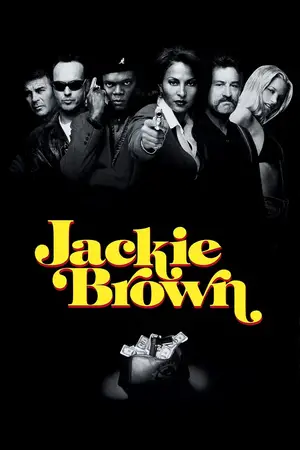
Before the body of Pulp Fiction was even cold, film bros everywhere were waiting to see what Quentin Tarantino would do next. He nabbed the Best Screenplay Oscar and the top prize at Cannes Film Festival, so after 1994, Tarantino had Hollywood at his disposal. Instead of cashing in, he chose to make the movie he wanted to make (one for them, one for me) and Jackie Brown was born.
Compared to his other eight films, this one doesn’t adhere to all the Tarantino-isms that he's known for. There's no high-octane action, no excessive violence, no overly stylized flare to pull the audience in. Jackie Brown is essentially a hangout movie-meets-character study-meets-romcom. The slow and restrained quality of the film is a turn-off for most of the ADHD-laden cinephiles that make up Tarantino's fanbase. Nearly thirty years later, JB is rarely named when people ask “What's the best Tarantino movie?” But I'm here to argue that, even if it's not objectively his best, it damn deserves a resurrection.

Why, you ask? To me, the appeal of the film—why I love it and why I think it can endure— is the charming dynamic and slow-burn romance between the titular character herself (played by Pam Grier) and bail bondsman Max Cherry (Robert Forster). Tarantino never has, and probably never will, go all in on love like this again.
Sure, there are sprinkles of romance in most of QT's films. Pulp Fiction had the passionate love between Butch and Fabienne, and ride-or-die sweethearts Pumpkin and Honey Bunny, but we never got to spend much time with either couple. Inglourious Basterds teases a spark between Shoshanna and Marcel, but they're tragically never given a chance to explore it. Django Unchained exists in the name of love, but Django and Broomhilda barely share any scenes together. You could argue that Mr. Orange and Mr. White from Reservoir Dogs had an iconic romance, but that's another article. None of those really do it like Jackie Brown does. It's the only Tarantino film that gives time and space for the budding romance between its two leads.

Jackie Brown is a 44-year-old divorced stewardess for Cabo Air, the worst airline in the biz. To make ends meet, she has a side hustle as a smuggler for criminal Ordell Robbie (Samuel L. Jackson), whose funds are kept in safety deposit boxes in Cabo. On a regular run back to LAX with a carry-on full of cash, Jackie is busted by the ATF and thrown in jail. Jail…bail…bail bondsman…you see where I'm coming from?
Enter Max Cherry, a 56-year-old crooked bondsman, who Ordell enlists to get Jackie out of the slammer. For Max, it's just another day on the job. He waits outside the jailhouse to meet his latest bondee, nary a clue of the woman he's about to lay his eyes on.
As Jackie makes her way across the prison yard, he realizes this is not his average clientele. Cue the ‘Natural High’ by Bloodstone needle-drop as an enamoured Max looks on and the camera slow zooms on Jackie. They decide to grab a drink on the way home, turning a routine client pick-up into more of a first date. Despite hitting it off, Jackie swipes Max’s gun from his car's glovebox when he’s not looking.
When Max returns the next morning to get his gun back, Jackie claims it was to protect herself from Ordell, but perhaps it was just to see Max again. They have coffee, he compliments her hair, and some cheeky flirts are exchanged. Max expresses his affinity for big butts, and Jackie claims hers has only grown since her twenties. She then puts on a record, and when Max asks what it is, she replies, “The Delfonics.” The next time we see Max, he’s at a music store buying the same album.

Despite the lowkey nature of their dynamic—I imagine sparks don't fly the same way in your late forties—Max and Jackie's chemistry stands out so much in the film because of its highly unromantic subplots. Over at Ordell's place, he's hanging with his former cellmate Louis (Robert De Niro), a gruff, antisocial, washed-up crook. Both men are shacking up with Melanie (Bridget Fonda) a young, pot-smoking surfer babe with a penchant for sticking her nose into their shady business. I won't go too far into their storylines, but let's just say it's not exactly romantic.
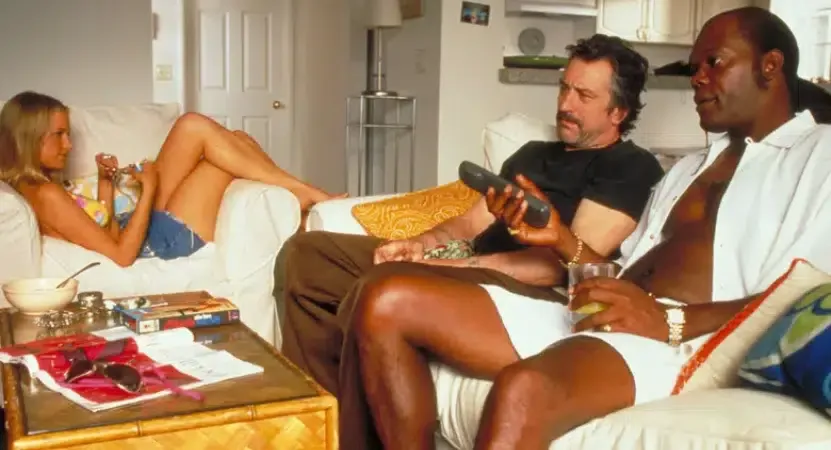
A chunk of the movie is just schemes on top of schemes. Plot twists after Plot twists, you could say. It's Jackie and Ordell versus the ATF. Then Jackie and the ATF versus Ordell. When pinned up against those narratives, the romance between Max and Jackie reads like one out of a Hallmark movie. The next time they meet, they talk about their next steps in life. Both of them have been involved in low-level crime for decades and are frankly tired of it. They don’t have the makings of a criminal mastermind, they are just trying to get by in the world. After Max expresses his desire to retire from bail bonds, Jackie makes him an offer he can’t refuse. The final scheme is now Jackie and Max versus everyone.
The two keep growing closer as they plan the plan to end all plans. Jackie, who at the start of the film was too embarrassed to be seen in a well-lit bar, is now around Max with her hair tied back and overalls on. He becomes her closest confidant, which is a big deal to someone who has been wronged by men so many times in the past. On the day of the final scheme, Max is in position browsing around a department store, waiting for his queue. When the sales associate asks if he needs any help, he proudly answers, “I’m just killing time, waiting for my wife.” It may have been to keep up appearances, but Max was giddy to call himself Jackie’s husband.

In a perfect world, they do get married. It has to be destiny that the only two good-natured people in this circle of corruption found each other. Neither of them are that naive, though. They know reality bites. The days of running away with a newfound lover are bygone. When the deed is done, Max and Jackie successfully finesse the money and “take care” of their enemies. Celebrations are in order, and for those two, it means finally embracing in a passionate kiss at long last.

Max knows Jackie has to skip town, and Jackie knows Max won’t follow her. This is goodbye for them, but it's not heartbreaking. What they found in each other is much more everlasting than a whirlwind romance. They reminded each other that mutual love, respect and excitement can still happen even when you think your time is up. From that, a new lust for life is ignited in both of them. They share a deep soul connection that cannot be severed by space or time.
One of the final shots of the film is a close-up on Max, his lips covered in Jackie’s rouge as he watches her walk away for the last time. The man’s love for her is as deep as his stare out the window. What other Tarantino film ends like that? He’s used to big exits, a battle royale or blood-filled blow-out. Max and Jackie's unquestionable chemistry and everlasting bond is what makes this film so exceptional. The simplicity of its conclusion is just as impactful and effective than any revisionist history grand finale. It doesn’t end happily ever after, because in real life, it never does.




Comments 3