Meditating with Andrei Rublev
General Reviews
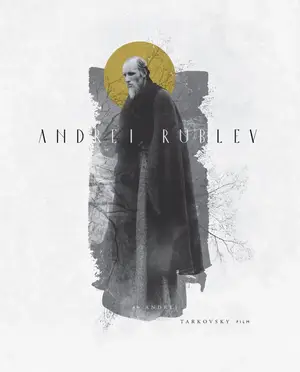
Andrei Rublev is a 1966 Mosfilm movie directed by Andrei Tarkovsky. It was written by Tarkovsky and Andrei Konchalovsky. The movie stars Anatoly Solonitsyn in his feature debut. After one 1966 screening in Moscow, the film was discontinued until a censored version was released in 1971. The original, full-length version is now available.
 The movie is an accurate depiction of Russia during the medieval era. Its story is not ultracomplex. In fact, it’s simple but, perhaps, the difficulty as a Westerner is having a limited frame of reference for the characters, places and issues of medieval Russia. I know little of invading Tatars. I knew even less about the movie's namesake, whom I had to look up after watching.
Andrei Rublev was an icon painter in Russia during the 15th century. Although medieval Russia and Orthodox Christianity are central themes to the movie, you don’t need to know your medieval history or be an Orthodox Christian to identify with Rublev. His story is one that any artist can relate to or anyone who has put blind faith into something, someone or themselves. The movie depicts eight episodes from his life.
However, before the episodes begin, there is an odd prologue. A man attaches himself to a hot-air balloon and takes off into the sky. The camera looks down at the people on the ground. This has nothing to do with Rublev’s literal story but it is metaphorical. For me, it gave Andrei Rublev a sense of divine voyeurism, as the camera often floats throughout space during the movie. The cinematography of Vadim Yusov is angelic, at moments, perhaps to mimic the angels in Rublev’s famous Trinity icon.
The most clear-cut episode in Andrei Rublev is the final one, “The Bell.” In this, a young man played by Nikolai Burlyayev convinces a town that he knows the secret to bell making. Thus, he gets the commission to build the town’s bell. This episode has some legendary shots, like the Randian depiction of Burlyayev watching the first pour of molten metal.

Tarkovsky said that horses, for him, symbolize life. Horses appear at intermittent and significant times throughout the movie. Perhaps it is a link between nature, life and art. Horses, a natural phenomenon, represented life, to Tarkovsky. For Rublev, art is his life and thus life is connected through the director and protagonist by art and nature, creating a trinity of connected themes.
Continuing with nature and along with horses, trees seem symbolic in Andrei Rublev. At the start, when the trio of Rublev, Kirill and Daniil leave for Moscow, one of the men comments on a tree and how you take something for granted until you know it’s the last time that you’ll ever see it. Trees are also prevalent in Rublev’s Trinity, as the Oak of Mamre is one of the few things depicted in the icon. After discovering that Rublev’s most famous icon is Trinity, it was hard not to remember moments in the movie where three things were used. Is this why Rublev is first seen leaving for Moscow in a group of three?

The movie being episodic causes a revolving door of characters, and it is sometimes difficult to keep up with the changing faces. At times, I wondered whose story I was watching. With that said, some reappearing faces, like the jester’s, are instantly recognizable.
This is a movie that warrants rewatching. Not because it is highly stylized like In The Mood For Love but because it has an dense, intricate story like Miller’s Crossing. On first watch, don’t be surprised if you are completely confused about what is going on. That’s how I felt during most of it too. And even though it is slow and long, I want to watch it again because I'm confident in the movie's subtlety.
If religious movies bug you, Andrei Rublev probably isn’t for you. But if you like meditating on the spirit and art, and are in the mood for a long, slow-paced movie with bleak and beautiful mise en scène, then try this Russian classic. It may leave you with more questions than answers, but I believe Tarkovsky left it all there on the screen for us to decipher over multiple watches.


Comments 0
No comments yet.