Gladiator II Gives Us Bread and Circuses, but is That Enough?
General Reviews
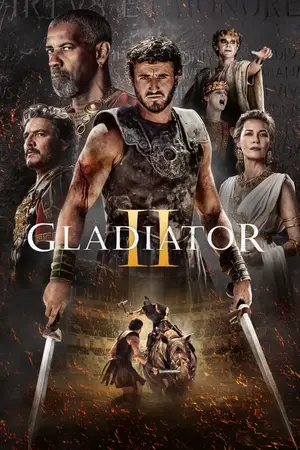
Twenty-four years after the original, Ridley Scott returns to the Roman Empire with Gladiator II, this time enrolling Paul Mescal, Pedro Pascal and Denzel Washington to bring the great civilization back to the silver screen. Gladiator II is loaded with visually stunning scenes and top-notch action, but it struggles to develop an interesting plot that isn’t full of simplistic, repetitive dialogue.
This time around, Mescal is our champion. He plays Lucius (aka Hanno), the son of Russell Crowe’s Maximus from the first movie. Hanno has started a new life in Numidia with his wife and some chickens, largely disowning his royal family heritage. As we've seen in countless movies, a man can only outrun his past for so long. When the Roman Empire shows up on Numidia’s shores, Hanno fights them with valour but, ultimately, sees his wife murdered while he is enslaved by the Empire.
The murder of his wife motivates Hanno to pursue revenge on Pascal's General Acacius. Although Acacius may not have fired the arrow, he is the one who ordered the killing. Thus, Hanno must have his head.
However, although all this happens in the movie's first 10 minutes, Hanno's motivation falls quickly into question. For a guy mourning the loss of his beloved, he does an awful lot of laughing and shooting the breeze with his fellow enslaved gladiators; even going as far as to give them a quasi history lesson as they pass through Rome's decrepit gates. Instead of chilling with the homies, shouldn't Hanno, you know, grieve? And, later in the movie, his motive completely changes with little build up, making it as believable as a she-wolf suckling two human boys back to health. Instead of being an organic change, Hanno's motive switch felt more like the writer, David Scarpa, redirecting the plot for his own benefit; that is, to extend Gladiator II to an epic run time despite the lack of narrative structure to justify the length.
Throughout the film, Washington's Macrinus repeatedly tells Hanno that his best quality is his rage. However, that is not the Hanno that we get to know. His rage, in fact, hardly characterizes him, other than one scene between him and Lucilla (played by Connie Nielsen). The Hanno that we get to know is reserved, compassionate and a master strategist. Despite Macrinus telling us that Hanno is full of rage, Scott and Scarpa rarely show us this rage. Like at other points in the movie, they assumed that telling us he is full of rage is enough to make us believe that he is. Unless the point was to show Macrinus as someone who misreads people, which is unlikely considering how he plays the rest of the characters like puppets, this telling rather than showing is simply bad moviemaking. In movies, it's always, always better to show the audience rather than tell. This is filmmaking 101 and, the worst part is, I'm sure that Scott knows this.

There’s no doubt that veteran director Scott and cinematographer John Mathieson can shoot a movie. Gladiator II is visually spectacular, with grandeur and gore that is seldom seen in modern cinema. Swords slice through chests, arrows pierce to the heart, vicious animals wreak havoc on humans, limbs are unceremoniously dismembered. However, like the bread and circuses of Ancient Rome, the breathtaking visuals seem to mask the hollowness of the plot.
This hollowness is especially evident in the repetitive dialogue. Marcus Aurelius is name dropped multiple times and passages from his Meditations are quoted at least twice. Hollywood can’t seem to get enough of Aurelius, as he’s also name dropped at least three times in Megalopolis. It’s nice to see that Hollywood big wigs can still read. However, I would have appreciated some deeper references to the Roman Empire. Yes, the reference to Romulus and Remus is authentic and nice, and the Colosseum set is epic and gorgeous, but most of Gladiator II's anecdotes feel superficial and implied rather than rich and exhibited.
Take the co-emperors, Geta and Caracalla (played by Joseph Quinn and Fred Hechinger, respectively). Gladiator II tells us that they’re tyrants, but do we ever see them do anything tyrannical? Other than Caracalla’s blood thirst, there is little that shows us how evil these two are. Their youth exposes their inexperience and their white makeup exposes their classist beliefs. But if an uprising is brewing then the audience must see that these rulers deserve it. Why not include a scene where they crucify Christians or pass legislature that cuts grain supply to the citizens? To just say that they deserve to be overthrown and have the uprising as a secondary plot point is not enough to get us rooting for their downfall.

You could argue that to include scenes showing Hanno grieving his wife, the co-emperors crucifying Christians, the economic effects of Rome's multifront wars and the support the army has for General Acacius would push the movie to an unmanageable length. Instead, with the 2.5 hours allotted to Gladiator II, Scott decides to show spectacle. Why make Hanno's grievance for his wife consistent or Geta and Caracalla's tyranny evident when you can show a massive rhino pulverizing a gladiator to death? Why show the intricacies of a coup d'état when you can have mega-jacked baboons viciously attack a mega-jacked Mescal? Thousands of years ago, Romans cared more for watching these “games” than they did for following the often-murderous politics of their time, so why should modern audiences be any different?
“There are no bad lines; just bad actors.” Gladiator II puts this axiom to the ultimate test. Look no further than Washington's performance as Macrinus. Washington is, far and away, the greatest performer in this movie. And he's largely dealing with garbage dialogue. I usually don't like to harp on a screenwriter or dialogue, because I believe in the slogan at the start of this paragraph. However, Gladiator II is an exception. True, repetition is a great literary device and, when used properly, it helps drive home a movie's themes and motifs. Gladiator II's use of repetition feels more like the screenwriter didn't believe the audience could handle an intricate storyline. The writer is happy to repeat plot points over and over rather than to build a rich story. Outside of the repetitive Aurelius references, there's also the many times that Hanno's history is questioned. Yes, this is the central point of the movie (even though we know he's the son of Maximus from the movie's trailer), but that doesn't mean the movie must explicitly tell us that that is what we should be looking act. It's like Scarpa story developer Peter Craig had never heard of subtlety.
But, back of Washington. His character's dialogue is no better than anybody else's. But, Washington being Washington, he delivers his simplistic lines with creative flair that makes gold out of nothing (much like his character does in the movie). It is the actors duty to elevate bad dialogue to something great. There's nothing great about a man yelling, “Stella!” But, when Brando does it, it's magic. Same here with Washington. Through pauses, inflection, facial contortion, body language, Washington brings Macrinus vividly to life and gives Scarpa's script much more credit than it deserves.

From the siege of Numidia, to the multiple Colosseum fights, to the epic final showdown, Gladiator II is packed with action spectacle that is visually stunning. The movie is sure to please those that feel like Hollywood has gone soft with its violence and lack of gore. But to those that want Hollywood to make a Roman epic with a fascinating story to match this fascinating era, Gladiator II will leave you wanting. As Scott did with last year’s Napoleon, Gladiator II delivers amazing action sequences at the cost of a more nuanced plot.
Modern audiences may still often think about the Roman Empire, but, since it lacks a captivating story, Gladiator II is doomed to have a short-lived stay in our collective conscious.





Comments 1