VIFF '25: Blue Heron
General Reviews
I believe that many films have the valuable power to stay in your mind, and rather than giving you answers or visceral triumphs that appeal to immediate feelings, what they leave you with is a question that lingers for hours, days, weeks, or even a lifetime. These types of films mark a turning point for those who see them, and I have no doubt that Blue Heron will be just that for someone out there.
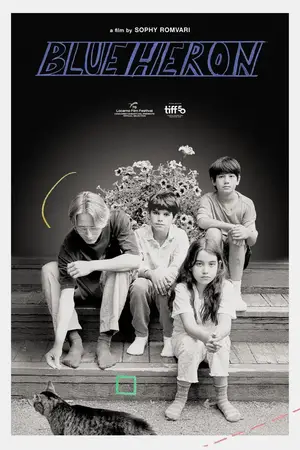
The film introduces us to a family of six who move to Vancouver Island. Little by little, we see how the eldest son begins to exhibit erratic behaviour, clearly related to a mental illness that even his parents do not understand and that, in the 1990s, did not have the medical or social tools to be treated properly. All of this is shown through the portrait of a family that wants to stay together but does not know how to do so.

Although the film introduces the youngest daughter, Sacha, as the apparent protagonist, it is actually in the second half that she fully emerges as the narrative centre. Until then, both the family and we, the audience, remain mere observers of Jeremy's enigmatic behaviour. The way Romvari directs him and places him within the story is brilliant.
Jeremy, the eldest of the siblings, with a considerable age difference from the others, enjoys making them uncomfortable and challenging them. On screen, he almost always appears isolated in the frames, hidden in silhouettes or negative spaces that reveal that his mind is elsewhere, somewhere we can never enter. This distancing forces us to experience the same questioning that his family experiences.

It is inevitable to compare Romvari with Charlotte Wells and her Aftersun. Not only because both are debut directors with enormous sensitivity, but also because both address the need to reconcile not only the family figure, but also the memory we carry of them: a memory made of affection and love, but also of pain and conflicts that mark the fragility of the human condition.
Although I find the way Romvari portrays family life in the first half of the film fascinating, making Jeremy the narrative engine, it was in the second half that the film completely won me over. There, she transforms fiction into a kind of hybrid meta-film with documentary, confronting us with the idea that these problems are not a thing of the past. We could excuse ourselves by thinking, "It was the nineties, they didn't know how to act," but the truth is that even today we still don't quite know what to do. That tension between past and present, between what we did right or wrong and how to reconcile both sides, is deeply powerful.

She does so with a subtlety reminiscent of what Andrew Haigh achieved in All of Us Strangers, interweaving layers of fiction and memory in an almost imperceptible way. And that is why I feel that Romvari is a filmmaker who has not only delivered an exceptional film, but also heralds a future that I look forward to following closely.

Comments 0
No comments yet.