VIFF ´25: Dracula
General Reviews
During the festival, I heard several people expressing annoyance, even irritation, with Dracula. There seemed to be a general feeling of disappointment, but as a fan of Radu Jude's work, I already knew what to expect: satire, provocation, and a healthy dose of self-aware pretension. So this may be one of the few positive opinions you hear coming out of the festival, but for me, this Dracula is a work that is both relevant and entertaining in its own twisted way.

The film follows a film director who decides to adopt artificial intelligence to tell the story of Dracula, through a series of vignettes and formats that fall apart before our eyes. Nothing goes as expected, and the film becomes an audiovisual essay on artifice, creation, and the absurdity of our digital age.

We have been living with generative artificial intelligence for almost a decade now, and although its presence is increasingly commonplace, the discourse surrounding it remains insufficient. There is still no regulation, no ethical consensus, not even a sustained conversation. That is why I find it so stimulating that directors like Jude or, in other fields, Harmony Korine use their cinema to provoke, to open debate and not necessarily to offer answers. Dracula works just like that: as a distorted mirror of the present, where art, technology, and banality collide.

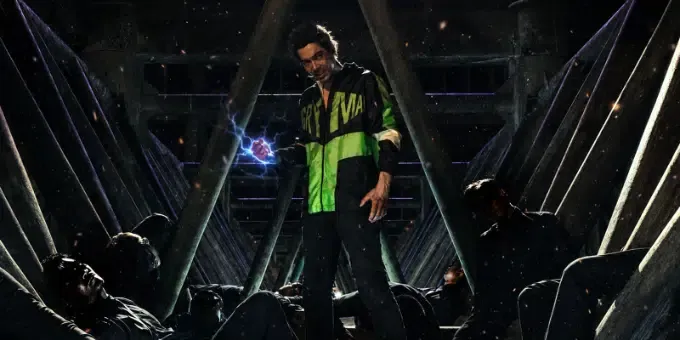
The film mocks commercial cinema's obsession with sexual stimuli, explosions, and visual excess, drawing a parallel between that saturation and the modern fascination with AI. There is something deeply disturbing about how Jude suggests that this search for immediate pleasure and constant entertainment can shape an authoritarian mindset, similar to other authors such as Alan Moore. In one of the most brilliant sequences, a local performance of Dracula in a small town ends up turning into a veritable hunt for the actor playing the vampire. What begins as a musical game turns into a party of collective violence, where no one seems to question what is happening. It is a grotesque, absurd, and brilliant scene because it accurately illustrates how stimulation, reward, and social apathy intertwine to dissolve any moral boundaries.

Another fascinating aspect is how Jude portrays the naive enthusiasm surrounding generative AI. That discourse so common on social media, where it is celebrated that “now anyone can make a movie,” is put to the test within the language of the film itself. Through his multiple versions of the Dracula myth, the director shows us how imperfect, inconsistent, and clumsily human these tools still are. Even when he integrates AI-generated images, he does so to expose their incompatibility with artistic sensibility: they are grotesque, flat, soulless.

I completely understand why some people hate this film. In fact, I don't think Radu Jude himself would mind if they told him so to his face. But for me, that's precisely why his cinema matters: because it continues to ask us essential questions about how we inhabit the digital world, how we consume information, and how we perceive reality after the pandemic. Dracula does not seek to please, but to provoke.

And at a time when much of the conversation around artificial intelligence is dominated by fear or empty fascination, I find it brave and deeply contemporary that Jude uses it to demonstrate its own limitations. That he incorporates it, distorts it, and ultimately shows us its failure as a narrative tool. It is a gesture that is as political as it is poetic: a reminder that art, even in its most imperfect form, remains a human creation.


Comments 2