VIFF 2025 | Blue Heron, and Finding Your Way Home
General Reviews
When I went to see Blue Heron, I had no idea what I was in for. All I knew was that it was a Canadian film, and it took place on Vancouver Island, where I grew up. Combine that with my festival goal this year—to see as many Canadian films as possible—and it was a must-watch for me. I sprinted across town to make it to this screening, and I'm so glad I did.

Seriously, not to toot my own horn or anything, but I made it from Commercial-Broadway to Howe in 15 minutes. Personal record.
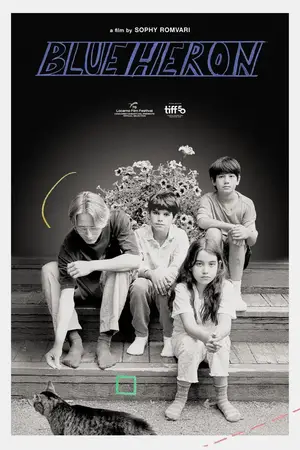
And by the end of Blue Heron, that wasn't the only kind of personal record I had experienced. It felt more like a home movie than a feature film, and I mean that in the best way. Blue Heron follows Sasha, an eight-year-old girl whose family emigrates from Hungary to Nanaimo. The film is about her family and their experience raising her older brother, Jeremy, who struggles with behavioural problems. Told through the refracted and fractured memories of childhood, the film deals with grief, nostalgia, and unanswered questions.

It's an incredibly personal narrative, clearly made in part to help the director/writer Sophy Romvari process her own thoughts around this semi-autobiographical story. I think for some, the hyper-specificity might make it harder to connect to Blue Heron, but I am not one of those people. Because it was also hyper-specific to me.
I've never personally had the experience of seeing the place I grew up represented on screen. My friends from Vancouver, Mexico City, Toronto, São Paulo, London, Amsterdam... They've all gotten to see the places of their childhood on film at some point, and I've got to admit, I was jealous. The way recognition lit up their faces when they saw a landmark, a street, or a skyline that they recognized was something I never thought I'd get to feel. Sure, I live in Vancouver now, and it's genuinely inescapable by comparison, but there's a certain nostalgic sentimentality attached to the streets you walked before you could drive, and the places that you remember more by feel than by any one memory.

The places I grew up will be part of my DNA forever, but my small town was too small to ever make it to the movie theatre. At least that's what I thought before this weekend.
In Blue Heron, my hometown of Nanaimo, BC was presented to me just as I remembered it. Complete with huge Dell desktop computers, rocky shorelines, and House Hippo commercials (iykyk). From the opening shot, I recognized Sugarloaf Mountain, home of the best sunset I've ever seen. I actually gasped in the theatre. Little did I know that the sense of recognition would extend far beyond familiar landmarks of my youth.

The movie is told from Sasha's perspective, and her uniquely childlike view makes the tragedy of the story all the more heartbreaking. Think Aftersun or The Florida Project. I loved how you can feel her parents trying and failing to protect her from the crisis that the family faces. As much as they try to soften the edges of reality, its harsh truths still manage to pierce Sasha's innocence. As the film progresses, Jeremy's refusal to follow the rules becomes harder to ignore and what starts as "acting out" slowly edges into the dangerous.

An afternoon spent running through sprinklers is punctured by an abrupt arrival, a serene day at the beach interrupted by a prolonged search. And Sasha is kept awake by snippets of overheard conversations coming from the other room long after she is meant to be asleep. I remember that feeling distinctly from my own childhood as well. Certain things aren't meant for children to hear, but old houses have thin walls.
Her brother Jeremy is unpredictable. He is mischievous, charming, kind, sullen, and at times volatile. The family is fighting to keep itself together and maintain a sense of normalcy, but as Jeremy's needs become harder to ignore, their tightly knit unit begins to unravel. When she grows up, Sasha endeavours to fill the holes in her memory in order to understand what happened to her brother. Her father's penchant for photography and home videos which are peppered throughout the film help her in her journey.
Those home videos could have come from my own house.

A group of kids jumping on a rusted out trampoline without a net.
A child tiptoeing across huge rocks on the seaweed-strewn beach.
A family fighting the gusting wind at the bow of a BC Ferry.
The view of the mountains through the tall grass at Neck Point.

All of these moments, suspended in time, felt like they'd been plucked directly from my own life and put on the screen. I should say this now—as we near the end—that this is not an objective point of view. It can't be. Sasha's own nostalgia and her feelings about where she grew up got all tangled up in my own, and honestly, I'm not all that interested in separating them. My own feelings only served to enhance the story that Blue Heron is telling.
The film touched me in a way that I didn't think I'd ever get to experience, and because of that, it will always be special to me. That being said, you don't have to be from small town Vancouver Island to connect to Blue Heron. It's a deeply human story about memory, perspective, and family.
So, I'll leave you with two recommendations.
1. Go see Blue Heron.
2. Watch the sunset at the top of Sugarloaf Mountain.




Comments 0
No comments yet.