My First Conjuring—and Why It Felt Like a Haunted House Ride
Directing
My very first Conjuring experience happened in Namibia, an African country. I caught the premiere of the newest entry in the franchise, The Conjuring: Last Rites. To be honest, it was a big disappointment for me per se, once again proving that I’m simply not the target audience for supernatural horror.

That doesn’t mean I’m too timid to handle horror. Quite the opposite: I have no religious faith, don’t believe in ghosts or spirits, sleep like a rock the moment my head hits the pillow, and remain utterly unmoved by tales of the paranormal. While traveling around the world, I was twice misled by navigation apps into cemeteries - once to attached to an Italian church and another a Turkish mosque. I was thrilled at first, thinking I’d booked myself into some quirky accommodation. The Turkish one even had the cheerful name “Peaceful Rest.”
Of course, horror and jump scares are two different things. That sudden moment when a bloody face leaps onto the screen without warning will still make my body jolt reflexively. I can’t say much about the earlier Conjuring films, but this so-called “Last Rites” relies almost entirely on those cheap jolts. For me, it's no different from wandering through a haunted house at an amusement park: bloodied and menacing performers pop out and quickly duck away before you can react, Honestly, I wouldn’t be surprised if some poor haunted-house actors have been injured by someone's instinctive swat or flying kicks.
Back to my Namibia screening. On its opening Saturday, the mall theater was packed with young moviegoers. After fifteen minutes of trailers, just as the film was getting started, a rowdy group of teenagers filed into the row behind me. “Great,” I thought, “my first Conjuring is about to be ruined by these restless kids.” But then I realized I should thank them. Their chatter, shouts, and jokes with each other actually took the edge off the film’s relentless jump scares, cushioning the assault on my nerves.
So what’s the real difference between this and a haunted house, when the film too is just people bunched together, trading banter and laughter to blunt the sting of demons and ghouls? Is that what my sub-$10 ticket bought me? Hardly a payoff. At least in a haunted house you can immerse yourself fully. With The Conjuring: Last Rites, all you can do is stay glued to the seat, popcorn and soda in hand, waiting for the next ghoul to lunge out of the dark.

After all that talk about the viewing experience, this write-up is turning into more of a “commentary on watching” than a straightforward film review. So let’s turn to the movie itself.
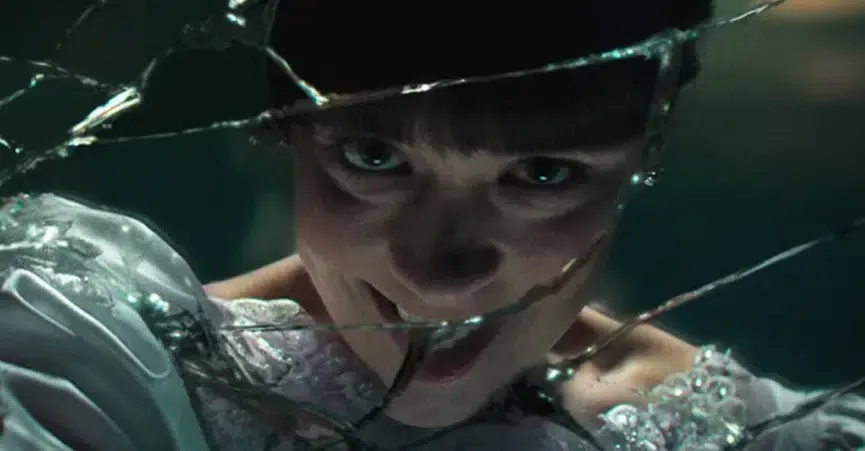
The story begins in 1964, when the Warrens encounter a cursed mirror—setting up two threads: the mirror’s sinister power, and the childhood of their daughter Judy. The narrative then jumps to 1986, where the Smurl family, an ordinary household in a Pennsylvania industrial town, find themselves increasingly tormented by the mirror's haunting. Though retired from exorcisms, the Warrens are drawn back for what is billed as their final case. Judy, possessed by the evil spirit, is ultimately saved through the combined strength of her parents, and together the family shatters the mirror and banishes the demon. Judy then moves on to a happy marriage, with the promise of peaceful days ahead.
Sound familiar? It’s as conventional a structure as they come: set up a conflict, then resolve it. The climax uses the most classic of devices—the last-minute rescue—intercutting the chaos inside the haunted house and the ordeals of various characters. In terms of values, it’s Hollywood tradition through and through: family power as the ultimate force of justice against evil. Even the visual language is straight from the rulebook. Horror and thriller films rely on a well-tested grammar of suspense: subjective shots that put the audience into the character’s cautious steps through a space fraught with unseen danger, followed by an abrupt switch to an objective reveal of whatever horror lurks there. The trick works, tugging at both curiosity and dread in equal measure.
But in today’s era, when cinema as an art form feels increasingly diminished, is this kind of refusal to step outside the comfort zone still acceptable? There’s nothing inherently wrong with using a tried-and-true structure, established pacing, and reliable camerawork, but shouldn't there at least be some spark of originality, even if only in the set design?
By contrast, take Final Destination: Bloodlines, the latest installment in that series. You can see just how much effort the Final Destination team put into designing their scare sequences. That franchise doesn’t really deal with the supernatural at all, yet its disasters and death scenes are grounded enough in reality that audiences can’t help but picture themselves in the same situations—and shudder in fear.
In Bloodlines, beyond the blood-soaked opening set piece of a collapsing high-rise, there’s an especially memorable scene: a guy covered in piercings is sucked into an MRI machine after it’s accidentally switched on. Not long after the movie’s release, life imitated art—a man in the U.S. actually died when the heavy chain around his neck was pulled into an MRI.
That’s the difference: Final Destination builds up its outlandish deaths with a foundation of plausibility, whereas The Conjuring: Last Rites has nothing left in its script toolbox but cheap jump scares.
This past month marked my first time watching either franchise. But after Bloodlines, I’m already planning to go back and explore the earlier Final Destination films. As for The Conjuring? I won’t be revisiting the earlier entries, nor will I bother with any potential sequels—even though this latest title, “Last Rites,” already sounds like a finale.




Comments 2