Diving into Despair: “Seven”
General Reviews
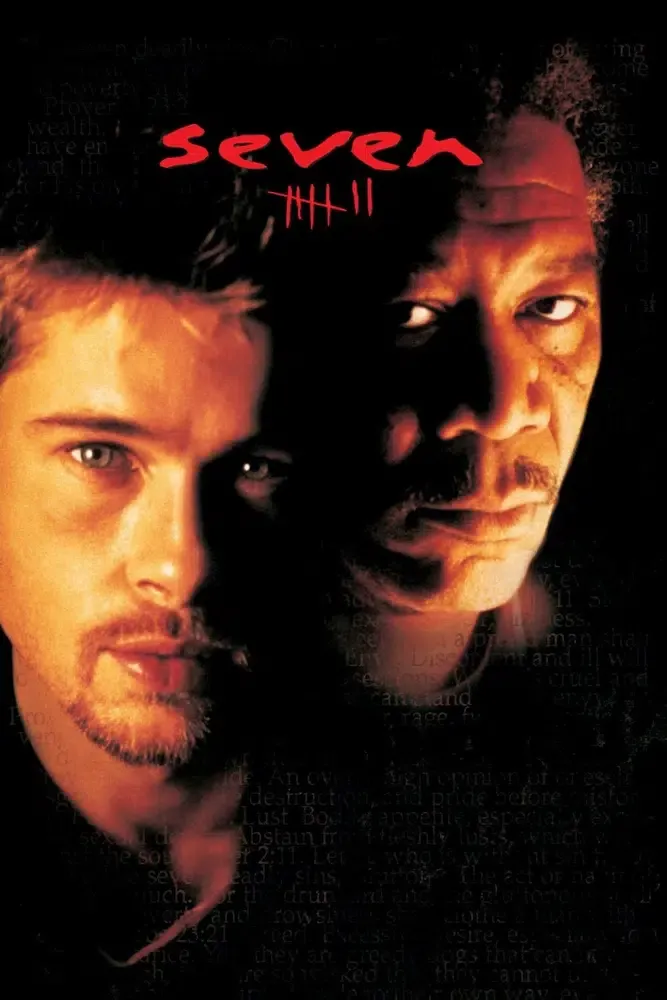
I watched 'Seven' late last night. It's a movie with strong religious undertones. Just thinking about the title reminds me of 'The Seventh Seal.' If Bergman, in 'The Seventh Seal,' questioned and explored the origins of faith and the existence of God, then 'Seven' shows us what the world might be like when trust is lost.

In the film, New York is depicted as a dark, damp, dirty, and chaotic place with a constant string of murders, resembling a living hell.
The story starts with two generations of detectives chasing a serial killer. It feels like a detective movie. The gruesome crime scenes and the macabre nature of the murders create tension from the beginning. By the time the third murder takes place, they realize the killer is using these killings to preach, punishing those who have committed what Catholicism considers the seven deadly sins: gluttony, greed, sloth, wrath, pride, lust, and envy. This is where the religious theme of the movie comes to the forefront and becomes even more pronounced as the plot progresses. Especially as it nears the end, the killer passionately claims that he is chosen by God to punish the guilty.

The movie suggests that the human condition is flawed, and the sinned will be punished. It carries a moral message, making viewers reflect on their own possible sins. However, it doesn't clearly explain why these people have committed these sins or why the killer finds it unbearable and chosen to deliver punishment in God's name. Is it because of a lack of faith? The Enlightenment discovered reason in the West, and since then, reason has been elevated to an almost supreme position. As a result, the human sense of self has expanded, reinforcing human rationality, and downplaying the role of God. Modernity, with science and technology at its core, has eroded religious beliefs, promoting the idea that reason can achieve everything. While reason, especially represented by science, has indeed driven rapid progress in Western societies and led them through modernization, it has also become a shackle on people. According to Zygmunt Bauman, modern society is increasingly dependent on rational elements like efficiency, calculation, and punctuality, resulting in a kind of 'rationalization' that values money and commercial value as the sole measure of worth, causing human relationships to become increasingly cold. The movie continually portrays the indifference of modern urban life. For example, when Somerset mentions that a woman was advised to yell "fire" instead of "rape" if she was being attacked on the street so that people would respond, it highlights society's apathy. David and Tracy, deceived by their landlord, live in a constantly shaking house near the subway. Even though he torments his tenant to the point of making him a living ghost, the landlord values him most highly because he regularly receives the rent in the mailbox.

Somerset's attitude represents the modern urban individual deeply disillusioned with the world. Witnessing a street robbery, he enters a taxi and, when the driver asks where he wants to go, replies, 'Far, far away...I don't know this place anymore...' He chooses to escape. His mindset is exposed in a bar conversation with David, who claims he won't react like Somerset, acknowledging the world's wickedness but still committing to fighting it. Somerset doesn't object; his mindset reflects that, and he realizes that he should confront the world actively and not escape. So, when he returns home, he smashes the alarm clock, which makes him feel lonelier, and, in the end, when asked where he'll go after retirement, he replies, 'Around...I'll be around.' However, David's persistence is not blind optimism; it's because he has the motivation and belief, which is his love for his wife. In the movie, you can see that David returns home after a conversation with William, holds his wife, and says, 'I love you very much...' But William's persistence is somewhat forced and merely a personal act.
This is a despairing movie that reveals the world's sinfulness and indifference, but it doesn't tell people how to prevent the worsening of this situation. Is it maintaining human goodness and turning to God? However, the movie shows that even Tracy, who represents human goodness, is brutally killed by the killer. The film showcases the darkest side of the world, completely obscuring the bright and warm aspects. David and Tracy's love is considered the one ray of light in this dark setting but ultimately fades away due to Tracy's murder. Where is the way out for people? Ultimately, the old detective William quotes Hemingway: 'The world is a fine place worth fighting for. I agree with the second part.' The ending lacks conviction; this world is not a good place. How can people find the motivation to struggle in such a world?

Moreover, an interesting observation in this film is the influence of new media on people's ways of understanding the world. The old and young detectives, William and David, represent two generations influenced by different forms of media. William grew up in an environment dominated by print media, probably born in the 20s or 30s when TV wasn't widely prevalent. On the other hand, David grew up watching TV. Therefore, they have entirely different approaches when dealing with the cases. Printed materials consist of characters that need decoding, memorization, association, summarization, and abstraction when read, representing a typical logical thinking process. William, following the logic shaped by print media, is good at detecting details and using them for logical deductions. When confronted with a problem, he even turns to classical texts, demonstrating a composed and cautious investigative style.
On the other hand, television combines visuals and sound, making it easy to understand without effort. People can easily grasp the popular language and visuals on television. Accustomed to a visually oriented world, David is depicted as noisy, impulsive, irritable, talkative, and prone to cursing. He constantly flips through a few crime scene pictures during the investigation, examining them repeatedly. William gives him some books by Dante, which he curses and throws in a drawer.

Furthermore, when William visits the library for research, he encounters a group of colleagues idling around. They spend the entire year in the library, drinking and playing cards. When William asks why they do not further their study, they sarcastically say they're cultured and then turn on a record, playing Bach's 'Air on the G String.' In the serene and peaceful melody, William contemplates, and they continue with their card game. The knowledge of the wise and the elegant music is disregarded, and in this context, the music appears to lament the degradation of civilization.

Lastly, the performance of Morgan Freeman, a highly respected actor, is simply outstanding, especially during the final scene when he responds to the police officer's question about where he will go after retiring, saying, 'around...I'll be around.' The movie creates a somewhat unconvincing ending because this world is not a good place. How can people justify fighting for it?"
I hope this paraphrased version captures the essence of the original article while being more reader friendly. Please feel free to ask if you need any further adjustments or have additional requests.




Comments 0
No comments yet.