Asteroid City :Why I Prefer "Asteroid City " Over Budapest
General Reviews

Ever since "The Grand Budapest Hotel," whenever a new film by Wes Anderson is released, there are always people saying that his movies are becoming too homogeneous, repeatedly self-referential. However, I find "The French Dispatch" and "Asteroid City " to be further experiments by Wes Anderson in making films more theatrical. This experimental aspect is initially hinted at in "The French Dispatch" and fully developed in "Asteroid City ." The film begins by informing the audience of its unreality, which, to me, shows a level of confidence akin to the spoiler of Colonel Aureliano Buendía's fate in the opening of "One Hundred Years of Solitude," trusting that the audience will still independently suspend disbelief despite knowing the film's lack of realism.

Some film enthusiasts strongly dislike the theatrical aspect in movies, while I hold a completely opposite view. I believe that movies should replace theater. Due to its nature, theater tickets cannot be priced lower than movie tickets. The cost of appreciating theater is much higher than that of movies, making it necessary to consider the audience more when creating theater. Movies, on the other hand, don't have this constraint. A truly liberated form of creation should be accessible and for the masses. The true barrier to a film is simply its ticket price. This is why I believe that understanding a film, at least its plot, themes, and atmosphere, should not require any additional material. Similarly, interpretations of a film without knowledge of any extra materials (such as a philosopher's theory, a comic's setting from the 1960s, or a director's newly invented technology for the film) should not be dismissed with a simple "you don't get it."
Returning to the film itself, "Asteroid City " is, in my impression, the first film after "Fantastic Mr. Fox" where two non-stereotypical characters delve into the state of life. Even "The Grand Budapest Hotel" did not explore to the depth found in "Asteroid City ." This distinction sets "Asteroid City " apart from the typical "Wes Anderson type" films, allowing critics to analyze the characters as they would with any other film. In other words, "Asteroid City " is closer to a conventional film compared to "The Grand Budapest Hotel." Simultaneously, "Asteroid City " has not lost Wes Anderson's signature style. Audiences who come expecting the "Wes Anderson" experience should not be disappointed. The film maintains Anderson's unique humor, color palette, editing, and camerawork.
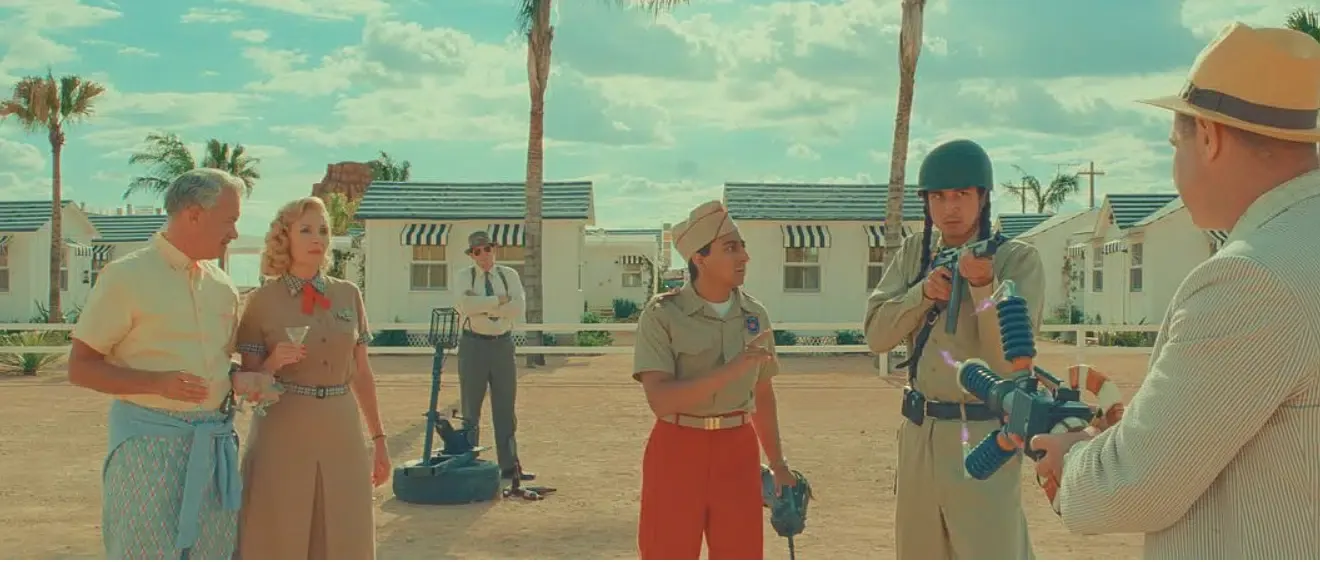
Now, a side note: the main reason I enjoy Wes Anderson's style has never been his meticulous composition or pastel color scheme. These elements serve what I consider Wes Anderson's most vital quality: deadpan humor. The composition and color scheme are employed to increase the emotional distance between the audience and characters, heightening the film's comedic effect. To me, this is a more sophisticated method for comedy in film than simply delivering punchlines.
Moving on, I'd like to discuss Wes Anderson's ambition in "Asteroid City ." This film has the smallest proportion of plot among Wes Anderson's works. The director even emphasizes the meaningless nature of the plot. The linear narrative of character states at the beginning and end of the film remains unchanged, but the test lies in the portrayal of the film's world and characters. The audience's attention naturally shifts to these elements, where Anderson can fully showcase his humor and stylization. While these elements presented here are not as rich as those in similar structured films like "The Royal Tenenbaums," they are part of Anderson's attempt at change. Within this narrative framework, the audience might even notice several seemingly set-up clues that are not developed in detail, such as the small inventions by the five prodigious children or the three girls who believe they are witches, and so on. These elements hint at a retro-futuristic vibe, including laser guns, jet packs, the Cold War, UFOs, aliens, etc. The witches remind me of Arthur Miller's play "The Crucible," which reflects the McCarthy era. Apart from stylization, these elements depict the backdrop of a (black and white, grim) Cold War. However, all these seemingly set-up elements are discarded during the chaotic climax. I think the director's intention was not only to amuse the audience but also to diminish the importance of "meaning" within the small asteroid city, emphasizing the absurdity of everything.
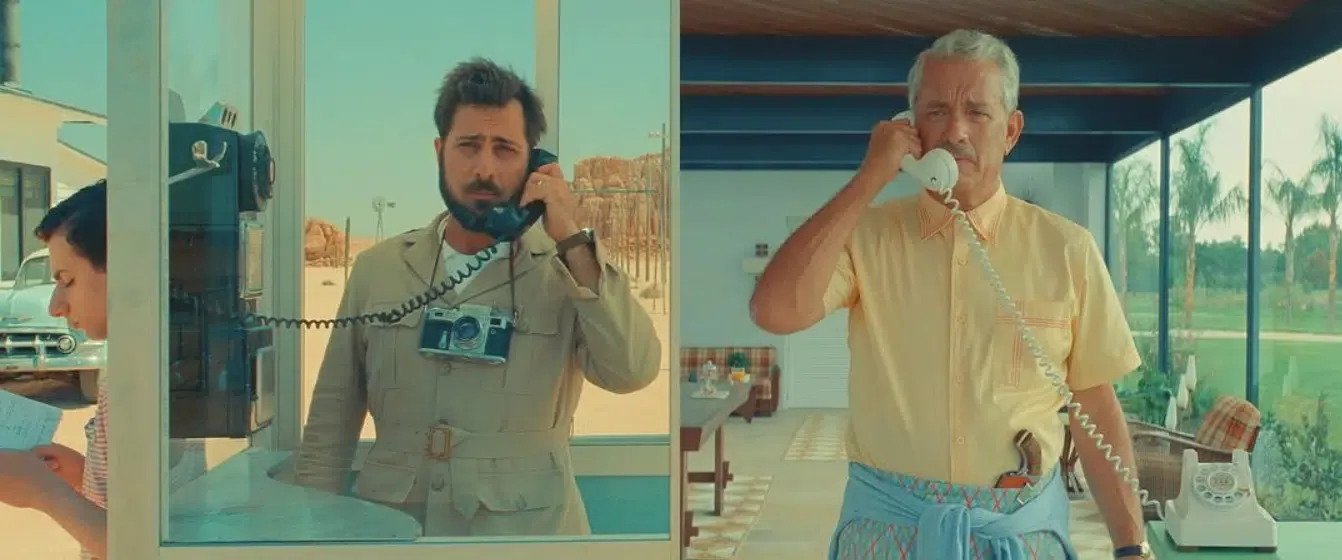
The film's theme, as stated by the writer portrayed by Edward Norton, is a group of people coming together to have a collective dream. In this dream, everyone confronts life's difficulties while showcasing them to others. The people in isolation are like characters in a dream, because after the isolation ends, everything becomes meaningless. However, the dream cannot be escaped, as life is not a dream and cannot be woken up from. The inhabitants of the small asteroid city were already in a state of difficulty before arriving. Divorce, widowhood, sexual orientation, property development, waning folk music, irreparable marriages – these are the nightmares people are unwilling to discuss. The children gradually fall into the endless repetition of names, and even geniuses find it hard to escape the paths of their predecessors. Ending isolation does not end life's problems. Isolation is not slumber; after isolation ends, whether one continues to deteriorate or chases after life's goals (such as love) depends on us.

One could argue that this film tries to capture the audience's attention through intertextuality and small details both within and outside the narrative. I don't think this signifies Anderson losing his charm, nor do I think he's stagnant. The connections between the film and its characters and the world outside are much stronger than those in "The French Dispatch." Both connections aim to deepen the film's themes rather than just experimenting with stylization. Those who come from "The Grand Budapest Hotel" might not necessarily like it, but audiences who have followed Wes Anderson's films from earlier on should enjoy "Asteroid City ." At least they won't hate it to the point of avoiding any of Anderson's films from then on. This is, at least for me, the happiest film I've watched in the cinema this year.







Comments 0
No comments yet.